Picodata: Shard-Per-Core In-Memory Database
0. Title
1. Three database architectures
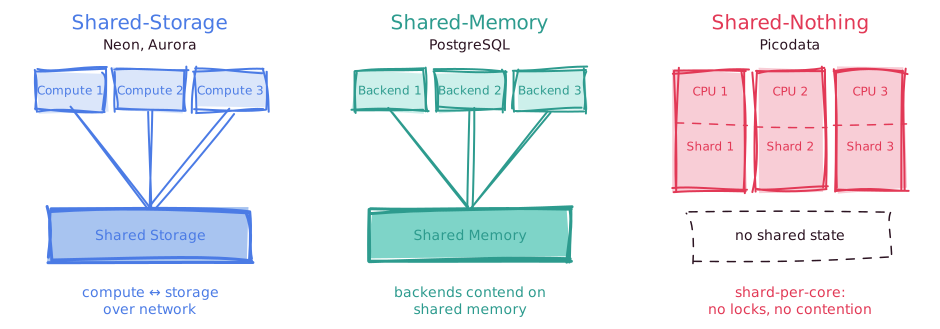
There are three major architectures for distributed databases. Shared-storage (Neon, Aurora) separates compute from storage — compute nodes talk to a shared storage layer over the network. Shared-memory (PostgreSQL) runs multiple workers inside one process, all contending on shared memory structures. Shared-nothing (Picodata) gives each CPU core its own shard of data — no locks, no contention, no shared state. This is the architecture Picodata uses.
2. Shard-per-core: a new architecture trend
Message-passing runtimes that partition work per CPU core:
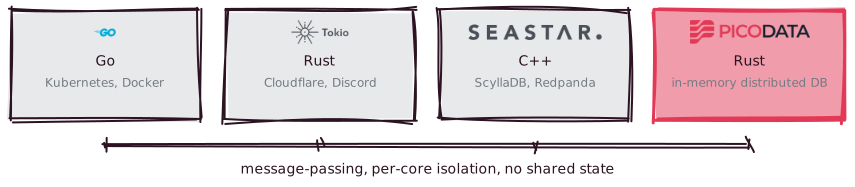
Shard-per-core isn’t a Picodata invention — it’s a broader industry trend. Go’s runtime, Tokio in Rust, and Seastar in C++ all use message-passing with per-core isolation. ScyllaDB and Redpanda are built on Seastar. Picodata applies the same pattern to an in-memory distributed database, using Rust and Tokio-style concurrency.
3. Picodata architecture
- One computer runs one DB process per CPU core
- Each process has an independent replica (or replicas)
- Replicas of one process form a replica set - the unit of cluster scaling
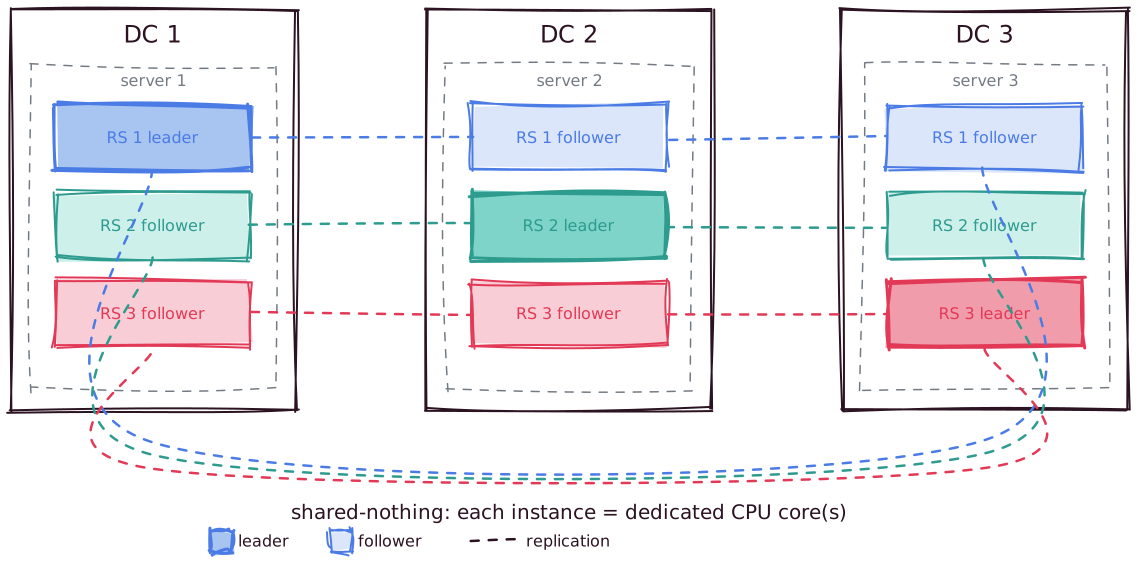
This is a shared-nothing architecture. Each instance runs on a dedicated CPU core and owns its data exclusively. Instances form replica sets that span failure domains (data centers). Each replica set uses Raft for consensus: one leader handles writes, followers provide read scaling and fault tolerance. Picodata is an in-memory database — 100% of data lives in RAM, persisted via write-ahead logging. “In-memory” doesn’t mean “volatile” — RAM is the primary storage tier, not a cache. This lets us use data structures optimized for RAM access patterns rather than disk page layouts.
4. Buckets: unit of data distribution
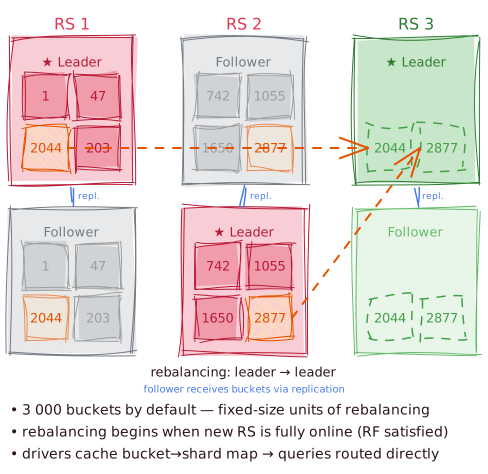
Data is split into 3 000 buckets (by default) — fixed-size units of distribution and rebalancing. When a new replica set joins the cluster, it starts with zero buckets. Rebalancing begins only when the new RS is fully online — all replicas present, replication factor satisfied. Bucket transfer happens leader to leader: the source RS master sends buckets directly to the destination RS master. Followers learn about the new data via regular replication — they never participate in rebalancing directly. Drivers cache the bucket→shard map so most queries go directly to the right node without an extra hop.
5. Data distribution
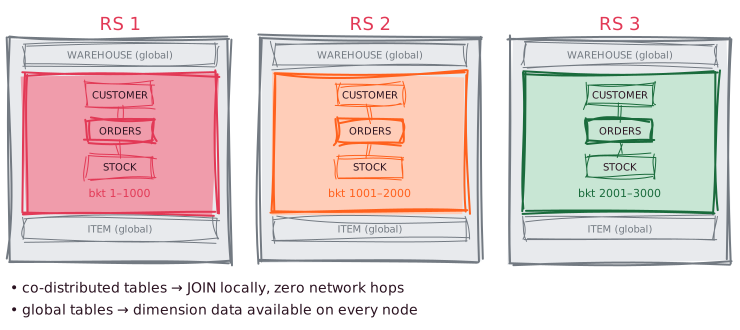
CREATE TABLE orders (...)    USING MEMTX DISTRIBUTED BY (o_w_id);
CREATE TABLE customer (...)  USING MEMTX DISTRIBUTED BY (c_w_id);
CREATE TABLE warehouse (...) USING MEMTX DISTRIBUTED GLOBALLY;
Tables sharing a distribution key are co-distributed — their rows land on the same replica set, enabling local joins with no network hops. Global tables are replicated to every node, ideal for small dimension tables (think star schema). Together, these let Picodata execute complex joins locally — the key to fast, horizontally scalable OLTP.
6. Failure domains and tiers
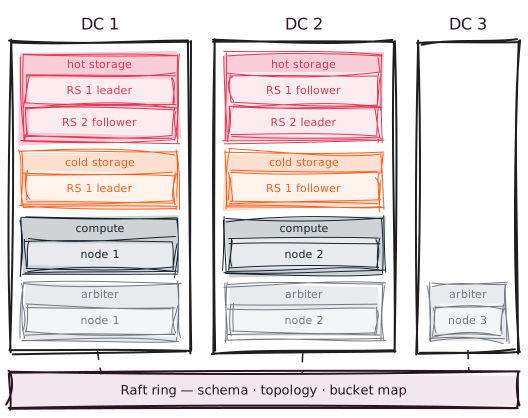
Each tier groups instances by purpose and has its own bucket count, replication factor, and
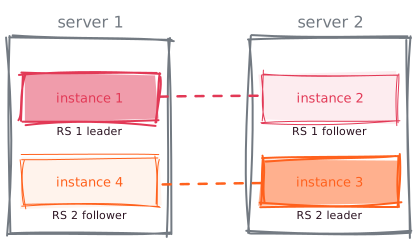
can_votesetting. Hot storage keeps everything in RAM for microsecond access. Cold storage uses the LSM engine (Vinyl) for large datasets that don’t fit in RAM. Compute tiers run SQL queries and plugins but store no data. Arbiter tiers are lightweight voters — they participate in Raft elections to provide quorum without storing user data. For example, a third DC can host just an arbiter tier — a single small VM that gives you quorum for automatic failover without the cost of a full DC. The data schema is global, but data and code (plugins) are local to a tier, so each tier scales independently. All instances across all tiers share a single Raft ring that maintains global cluster metadata: schema, topology, bucket map, users, and ACL. Failure domains are key-value labels attached to instances (like K8s node labels). Picodata uses them to place replicas in different domains automatically. Example config:DC=1, S=2 (servers/DC), NCPU=2 (instances/server), RF=2. If a server or DC fails, the system knows which replicas are affected and promotes followers in other domains.
7. Cluster assembly
# Start first node
picodata run --data-dir tmp/i1 --listen :3301 \
    --peer :3301 --init-replication-factor 2 \
    --failure-domain '{"dc": "dc1"}'

# Add more nodes
picodata run --data-dir tmp/i2 --listen :3302 --peer :3301
picodata run --data-dir tmp/i3 --listen :3303 --peer :3301
picodata run --data-dir tmp/i4 --listen :3304 --peer :3301

# Remove a node
picodata expel --instance-uuid a022c8f5-...24755e2d5c81
Assembling a cluster is just running the same binary with different arguments. The first node bootstraps the cluster, subsequent nodes join by pointing to any existing peer. Removing a node is a single
expelcommand. No configuration management required.
8. Availability & Scalability: summary
- Synchronous disk writes - durable persistence in sync mode
- Synchronous replication - a full DB copy in 2+ data centers
- Logical replication between clusters (similar to Oracle GoldenGate) - an asynchronous live copy for blue/green upgrades and DR
Picodata implements ACID guarantees with SERIALIZABLE isolation - the highest possible level.
The tier mechanism separates compute, operational, and archival storage. Each layer scales independently.
Production numbers: 10,000+ TPS per core, 2–100 TB managed data, up to 2,000+ nodes in a cluster.
We provide SERIALIZABLE isolation – the strongest guarantee in the SQL standard. Combined with synchronous replication, this means committed transactions are durable across data centers. You don’t need to choose between consistency and availability for normal operations. 2-DC deployment: leaders distributed evenly across both DCs. If one DC fails, the other has all data and continues serving reads. Writes need quorum, so a 2-DC setup uses an arbiter tier (a single small VM in a 3rd location). 3-DC deployment: each DC holds a full data copy. A transaction commits when written to at least 2 DCs. If any DC fails, the system stays fully operational (RTO 0, RPO 0). All DCs are active. Rolling upgrades with zero downtime.
9. Live demo
Three parts. Part 1 assembles a 3-node cluster with RF=3 — just
picodata runwith--peerpointing to the first node. Part 2 creates a user via the admin socket and grantsCREATE TABLE— the only extra privilege needed, since read access to_pico_*system tables is already public. Part 3 connects with standardpsql— the SQL is PostgreSQL-compatible,DISTRIBUTED BYcontrols sharding,USING MEMTXselects the in-memory engine. The_pico_instanceand_pico_tierqueries show all 3 nodes online in one replicaset with RF=3.
10. PostgreSQL-compatible SQL
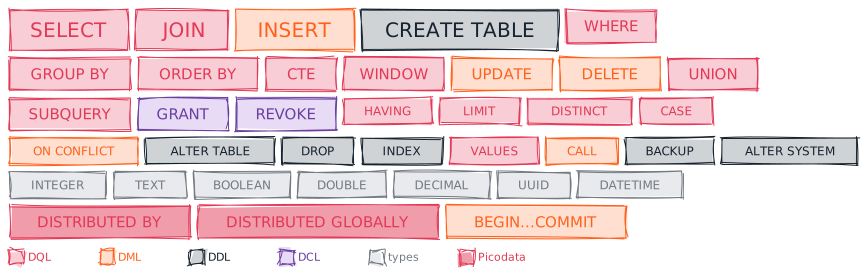
PostgreSQL-compatible type system: INTEGER, TEXT/VARCHAR, BOOLEAN, DOUBLE, DECIMAL, UUID, DATETIME, JSON.
Picodata implements a broad SQL surface compatible with PostgreSQL syntax and types. Queries, joins, CTEs, window functions, subqueries — all work as expected. On top of standard SQL we add
DISTRIBUTED BYandDISTRIBUTED GLOBALLYto control data placement across the cluster. The full reference: SQL index.
11. PostgreSQL wire protocol & tools
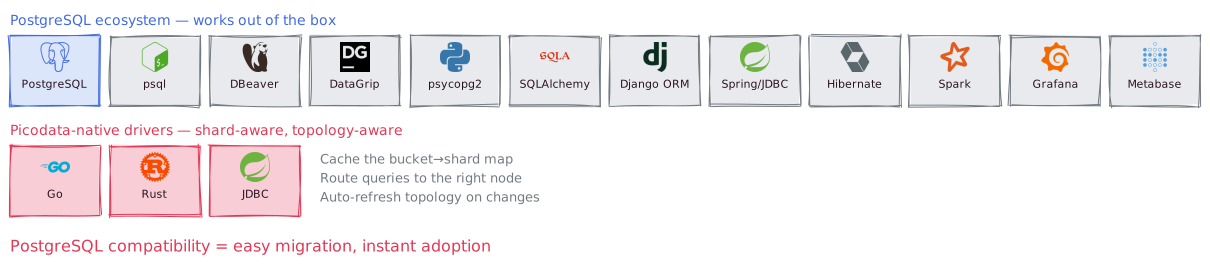
PostgreSQL compatibility means zero migration friction — your existing tools, ORMs, and BI pipelines work out of the box. DBAs use DBeaver, data engineers use Spark, developers use Django or SQLAlchemy. For high-throughput OLTP, our native drivers (Go, Rust, JDBC) are shard-aware and topology-aware — they cache the bucket→shard map and route each query directly to the owning node. No proxy, no extra hop.
12. Ouroboros & blue/green deploy
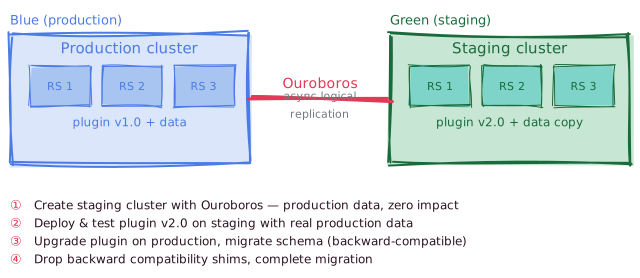
Ouroboros is a proprietary async logical replication engine (similar to Oracle GoldenGate). It maintains a second cluster as a live copy of production — bootstrap at ~3 Gbit/s (~5 min for 1 TB). You test new plugin versions and schema migrations on real production data with zero impact on production. Once validated, you upgrade the production cluster with confidence. Each step is backward-compatible, so rollback is always possible.
13. Co-located compute — why plugins
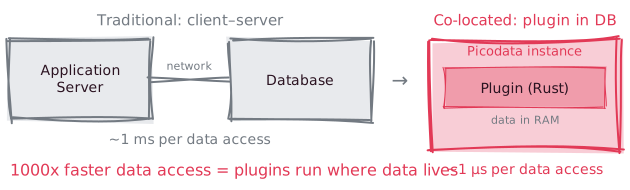
- Plugins are compiled Rust modules running inside the database process
- No GC pauses, type-safe, shipped as a single binary
- Standard source control, testing, and CI/CD — just a Rust crate
Traditional architectures put a network boundary between application and database — every data access costs ~1 ms. Picodata plugins run in the same address space as the data. A hash table lookup in RAM takes ~1 μs — that’s 1000x faster. This is the key reason plugins exist: they bring compute to where data lives.
14. Plugin lifecycle
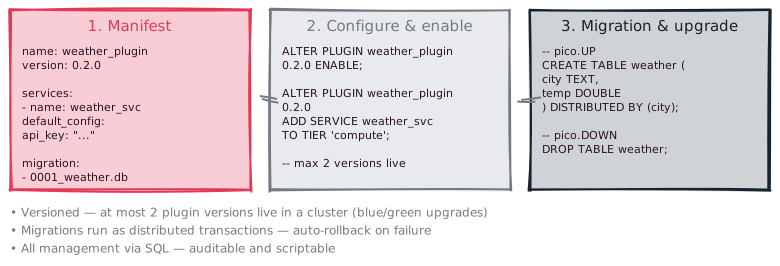
A plugin is described by a manifest (like
package.json), uses migrations with UP/DOWN for schema changes (distributed transactions, auto-rollback), and is managed entirely via SQL (ALTER PLUGIN,ALTER SERVICE). At most 2 versions can coexist in a cluster for blue/green upgrades. Configuration is strictly consistent across all nodes.
15. Use cases
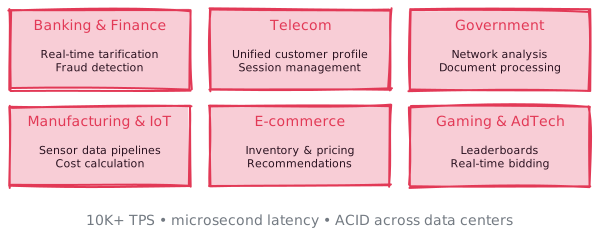
High-throughput OLTP with microsecond latency, ACID, and horizontal scaling.
Banking & Finance: real-time tarification, mobile banking statements, fraud detection — top-10 banks in production. Telecom: unified customer profiles, real-time session management. Government: visual network analysis for federal authorities, document processing pipelines. Manufacturing & IoT: sensor data ingestion, real-time cost calculation. E-commerce: inventory and pricing engines, recommendation systems. Gaming & AdTech: leaderboards, real-time bidding. Common thread: high-throughput OLTP that needs microsecond latency, ACID guarantees, and horizontal scaling — all in one product.
16. Thank you & reach out